01 · Evaluate continuously
Check outputs against real buyer language on a set cadence. Drift is quiet by design.
 Youssef Agouzoul
LLMs have radically changed how we work, making knowledge easier to access and outputs faster to produce. But more output is not more impact. The challenge is to use that leverage without sacrificing understanding, judgment, or quality. Product Marketing still needs to focus on the outcomes that drive revenue.
My take
The biggest risk is already visible. LLMs average by construction. They reach for the safest, most common phrasing. Used carelessly, they push product language toward fuzzy words that say less clearly what the product is about, exactly as recent studies are pointing out. (Les Échos, 07.26)
For Product Marketing, positioning and messaging exist to make a product's differentiators legible to the right buyer. Flatten the language, and you flatten the one thing meant to set the product apart.
Being deliberate and methodical is part of the answer. Here are the principles I apply to keep using AI while building judgment.
01 · Evaluate continuously
Check outputs against real buyer language on a set cadence. Drift is quiet by design.
02 · Keep a human accountable
Every output carries a source, an owner, and the person who reviewed it.
03 · Reinvest in judgment
Put the time saved into users, buyers, the product itself, and the reference documents everything else is built on.
Initiatives
Market & competition
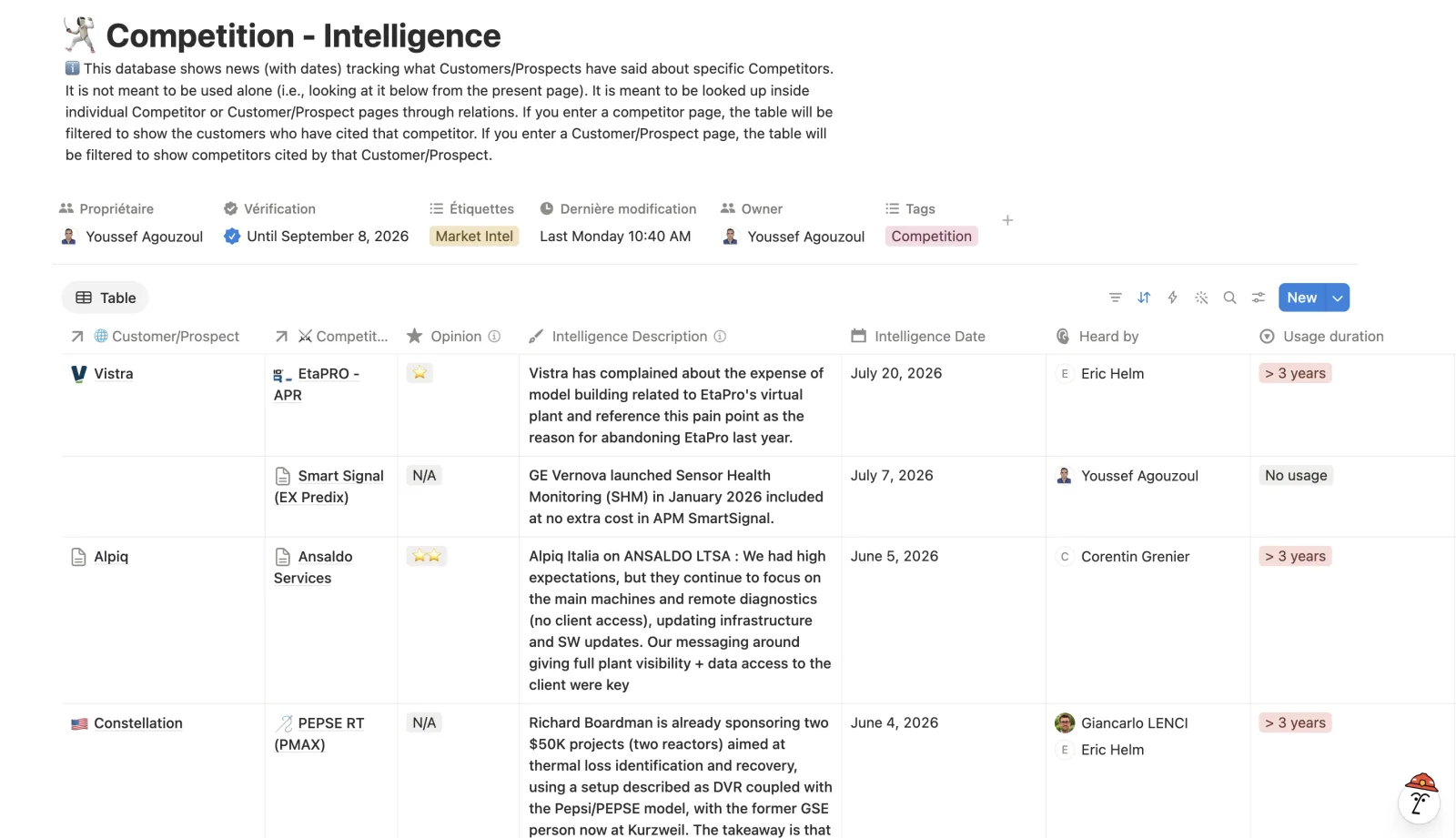
Weekly scan of competitor announcements and positioning shifts, posted straight to our #competition-news Slack channel. It scans news weekly and assesses how competitors' positioning evolves each month.
Tools
Weekly call debrief
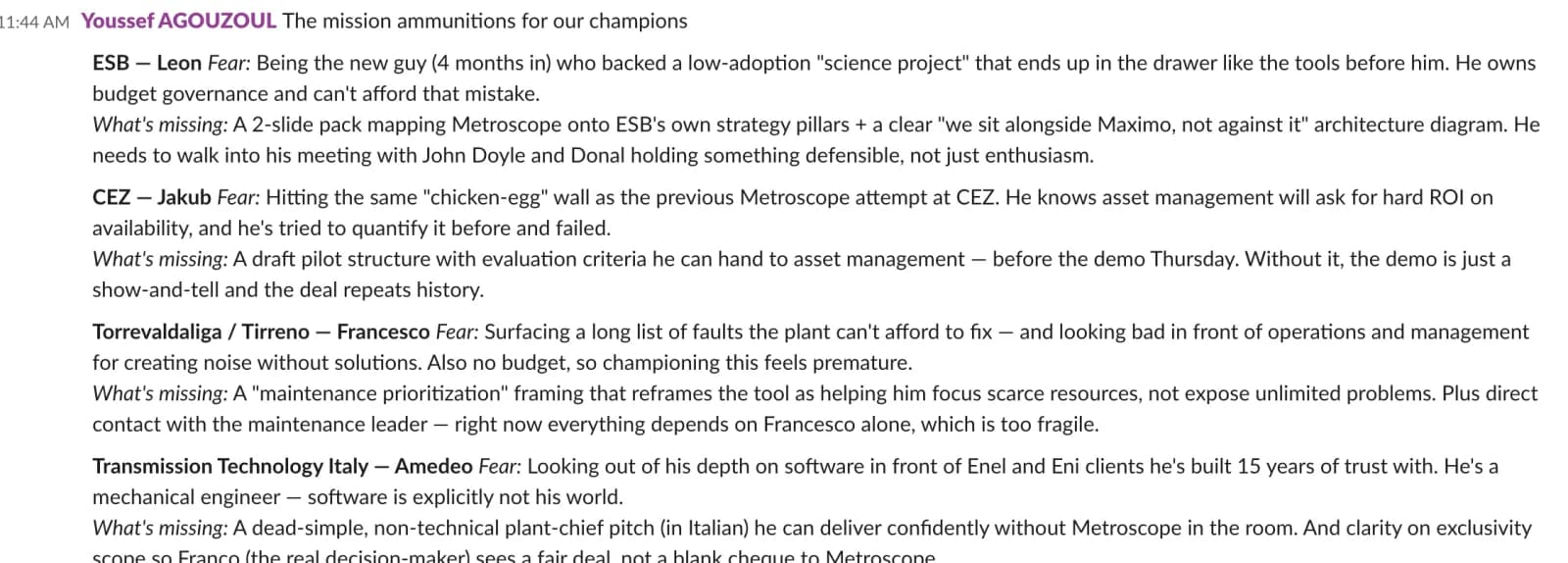
Every sales call gets recorded in Modjo; the agent pulls the week's transcripts and summaries, and surfaces recurring patterns. One real output: “Champions struggle to sell Metroscope internally. Champion enablement is therefore the #1 bottleneck,” seen across six unrelated deals in the same week.
Tools
Sales enablement adoption
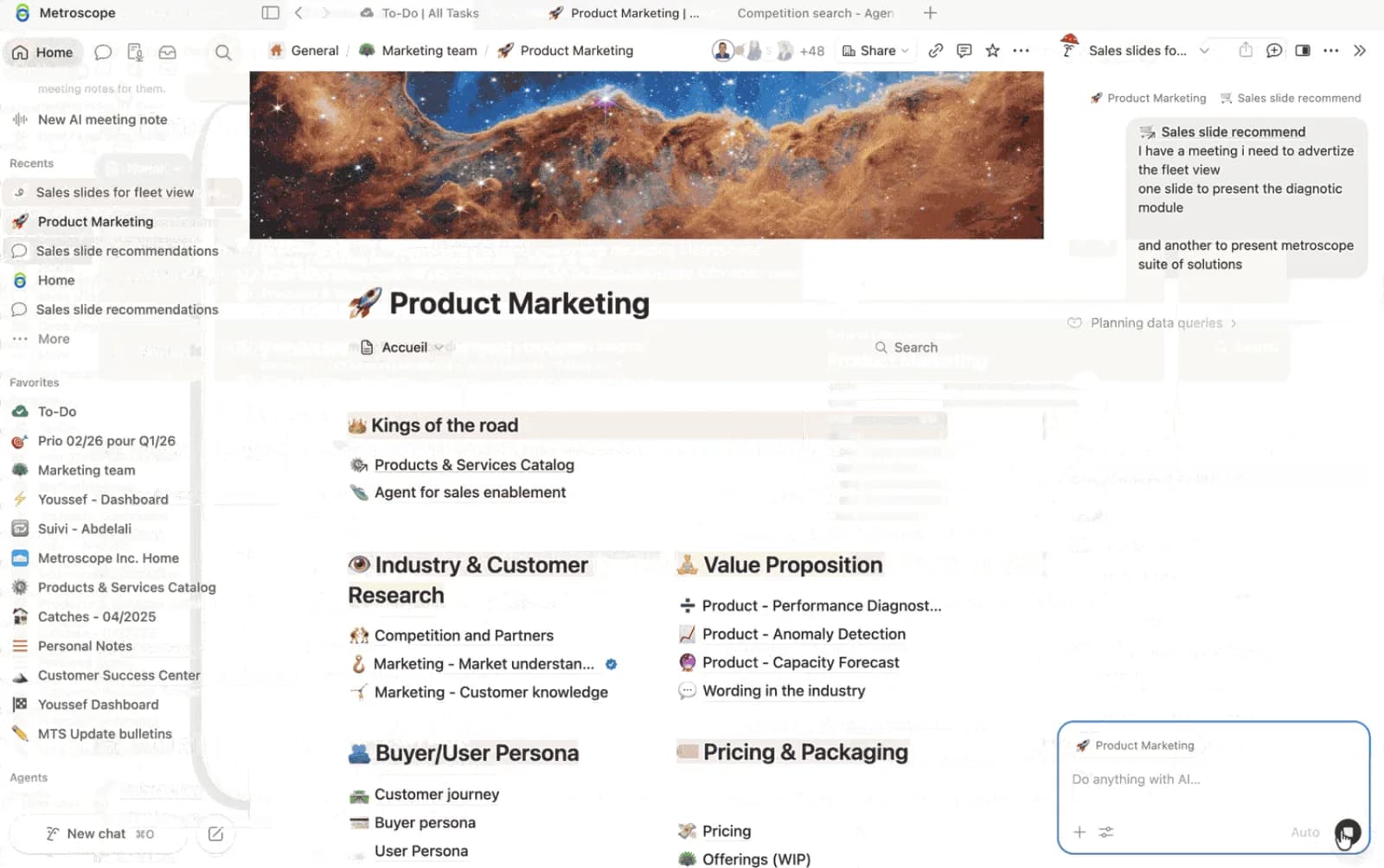
Lives in the Product Marketing Notion space. A rep types the use case they're walking into, and it searches the slide table and deck registry and returns the best existing slide with a deck link and slide number. It doesn't create anything.
Tools
Use cases
| Area | Core problem | What changes |
|---|---|---|
| Competitive intelligence | Battlecards age quickly and market checks stay reactive. | Monitor sources on a cadence, extract changes and deliver a traceable digest. |
| Launch content | Every asset starts from a blank page. | Turn one validated brief into channel-ready drafts without losing the hierarchy. |
| Launch planning | Workback plans hide dependencies and drift. | Back-calculate milestones, surface dependencies and flag missing owners. |
| Market research | Research is slow, fragmented and hard to trace. | Structure queries, synthesise themes and keep sources attached. |
| ICP & messaging | Personas become generic and disconnected from the product. | Map real buyer language and product capabilities to a sharper message. |
| Sales enablement | Training is passive and retention is invisible. | Create practice, checks and nudges that reveal where confidence is missing. |
| RFP response | Answers are reused long after they become outdated. | Draft from validated knowledge and keep the evidence visible. |
| Cross-functional knowledge | Positioning context is scattered across docs, Slack and calls. | Create a source-backed reference layer for recurring questions. |
Prompt library
Open a card, replace the brackets with your context and ask the model to push back, not just fill in the blanks. AI removes manual assembly. It does not remove the judgment call about what is true and worth saying.